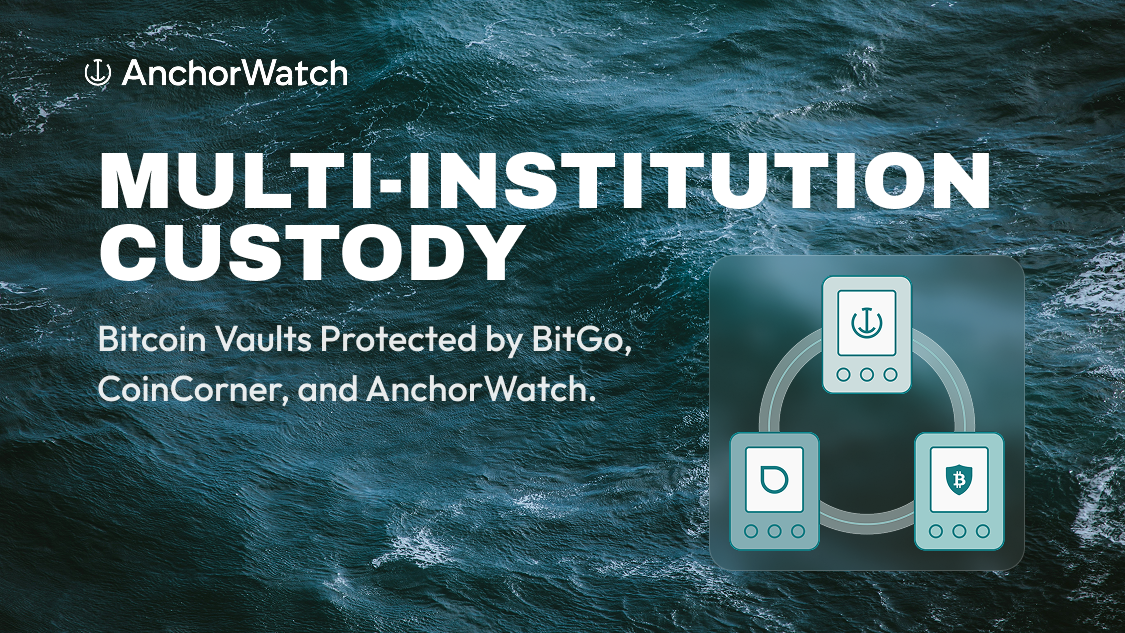
Introducing AnchorWatch Multi-Institution Custody, Available Globally
AnchorWatch
The real test of a Bitcoin custody plan is whether it still works when something goes wrong.
A hardware wallet gets misplaced. A seed phrase is stored incorrectly. A family member does not know what to do. An employee leaves. A trustee inherits responsibility for assets they did not set up. Someone receives a convincing fake message, phone call, or video asking them to approve a transaction. These are not edge cases. They are the real-world problems that long-term Bitcoin holders, families, businesses, and fiduciaries have to plan around.
AnchorWatch Multi-Institution Custody was built for that reality. It is designed for individuals, families, businesses, trusts, and treasury teams that want an easier, more fault-tolerant way to hold Bitcoin for the long term without personally managing hardware wallets, seed phrases, or physical backups.
Instead, signing responsibility is distributed across multiple independent institutional key holders. The client authorizes transactions, and two separate institutional key holders must sign before Bitcoin can move. No single institution can move funds on its own, with separation of duties so no single login, employee, device, or platform operator is enough to send Bitcoin.
That distinction matters. Multi-Institution Custody is not about giving up control. It is about separating control from operational fragility. You decide who is authorized to act, how approvals should work, and when Bitcoin should move. No institution can move funds unilaterally. Each institutional key holder secures a key and acts only on the client’s behalf after the required approval process has been completed.
The approval process is one of the most important parts of the model. In many custody failures, the problem is that someone tricks the right person into doing the wrong thing. A compromised email account, a fake login page, a spoofed message, or a convincing AI-generated video call can all create pressure to act quickly.
AnchorWatch Multi-Institution Custody is designed to slow that down. Before Bitcoin can move, an authorized person must confirm identity and complete a video verification call with each signing institution. Required YubiKey hardware authentication adds a physical security requirement so stolen login credentials and deepfakes alone would not be enough to move funds. Transaction details must be reviewed and verified before institutional signers participate. The goal is to make sure a transaction reflects the client’s actual decision, not a compromised account, manipulated workflow, or social-engineering attack.
For families, the model creates a clearer path for inheritance and continuity. A Bitcoin plan should not fail because the owner is unavailable, incapacitated, or deceased. Families should not be left searching for a seed phrase, and legal representatives should not have to reconstruct a technical custody setup during a crisis. Multi-Institution Custody gives clients a more durable framework for documenting who is authorized, how approvals work, and how the custody relationship should continue as circumstances change.
For businesses and fiduciaries, it creates cleaner governance. Organizations need defined roles, approval authority, continuity planning, and controls that can survive personnel changes. A company should not depend on one executive’s device. A trust should not depend on informal instructions. A treasury team should not have to make one person the entire custody plan.
AnchorWatch also manages custody around the way Bitcoin actually works: at the UTXO level. Bitcoin is not a generic account balance. It is made up of specific unspent transaction outputs. UTXO-level management creates a clearer connection between the Bitcoin being held, the vault structure protecting it, and the records needed for long-term planning. For holders, businesses, and advisors, this can support cleaner reporting, better organization, and cost basis management over time.
This structure also makes insurance possible. For eligible clients, AnchorWatch Multi-Institution Custody can be paired with a dedicated Lloyd’s of London property insurance policy issued in the client’s name and tied to the specific Bitcoin held in their MIC vault. The policy is connected to an identifiable UTXO set and is designed to respond to a complete and permanent loss of the ability to send Bitcoin from that UTXO set. Because all signing keys are held by institutional key holders, coverage is focused on institutional-level failure scenarios, including certain physical perils, malicious third-party events, in-person coercion under immediate threat of severe physical harm, and certain institutional collusion events.
Insurance is not a replacement for good custody. It depends on good custody. Multi-Institution Custody brings those pieces together: independent key holders, client authorization, hardware-based authentication, documented approval procedures, recovery planning, inheritance support, UTXO-level management, and optional insurance coverage for eligible clients.
Clients still decide when Bitcoin should move. Institutions act only within the approved process. The result is a custody model built not just for secure storage, but for continuity through the real events that long-term holders, families, businesses, and fiduciaries need to plan for.
Bitcoin was designed to last. Custody should be designed the same way.
To make an initial complaint, you should contact Arch Insurance at: The Complaints Manager Email: Complaints@archinsurance.com Arch Insurance (UK) Limited 4th Floor 10 Fenchurch Avenue London EC3M 5BN United Kingdom
In the alternative, you may wish to contact the Lloyd’s Complaints Department at:
Lloyd’s Complaints Department c/o Email: complaints@lloyds.comLloyd’s Phone: 1-844-849-7828 America Inc. 280 Park Avenue, East Tower, 25th Floor, New York, NY 10017, USA