The Flagship Single Key Vault: Self-Custody, Reinforced
A single lost device. A house fire. A $5 wrench. Most single-key Bitcoin setups have no answer for any of these. The Flagship 1-Key Vault was built to change that.
AnchorWatch
March 5, 2026
A single lost device. A house fire. A $5 wrench. Most single-key Bitcoin setups have no answer for any of these.
If you hold your own keys today and you have ever thought about what happens to your Bitcoin when something goes wrong, the Flagship 1-Key Vault was designed for exactly that concern.
The Problem With Bare Single-Key Custody
Single-key custody is the most common form of self-custody, and for good reason. One key, one device, full control. No third parties, no committees, no permission required.
But that simplicity comes with a specific set of risks that most holders never address until it is too late.
A seed phrase written on paper and stored in one location is a single point of failure, not a backup plan. A house fire does not wait for you to move your signing device to the safe. If you are incapacitated or killed, there is no mechanism for anyone to recover your Bitcoin unless you have already built that mechanism yourself. And if someone puts a gun to your head, a standard single-key wallet will do exactly what they tell it to.
These are not cryptographic failures. The math is fine. These are structural failures: the absence of enforced policy around how, when, and under what conditions Bitcoin can move.
The Flagship 1-Key Vault exists to close those gaps without taking control away from you.
What the Flagship 1-Key Vault Actually Is
You hold a single signing key on a supported hardware device. AnchorWatch holds additional keys in a separate keyset. Both keysets must independently authorize a transaction before Bitcoin can move. No single party, including AnchorWatch, can unilaterally move your funds.
This is not a custodial arrangement. It is a multi-signature architecture built on Bitcoin's own protocol using AnchorWatch's Trident Vault platform. Trident uses Miniscript to enforce spending rules, recovery conditions, and time-locked safeguards directly on chain. These rules are not company policies that can be changed at will. They are programmed into the vault at creation and enforced by Bitcoin itself.
Your Bitcoin is held in offline cold storage. AnchorWatch never has access to or a backup of your key information. You are provided with your vault's Recovery Script for use with Bitcoin Core if AnchorWatch ever becomes permanently unavailable.
Supported hardware signing devices include the Ledger Nano S Plus. Clients using uninsured vaults may also bring their own compatible hardware device.
How the Time-Locked Security Layers Work
The Flagship 1-Key Vault is not a static setup. It uses three time-locked layers that change the vault's behavior as time passes, creating fallback paths if something goes wrong. The vault comes in two variants, insured and uninsured, which share the same first layer but differ in how the recovery and sovereign layers are ordered.
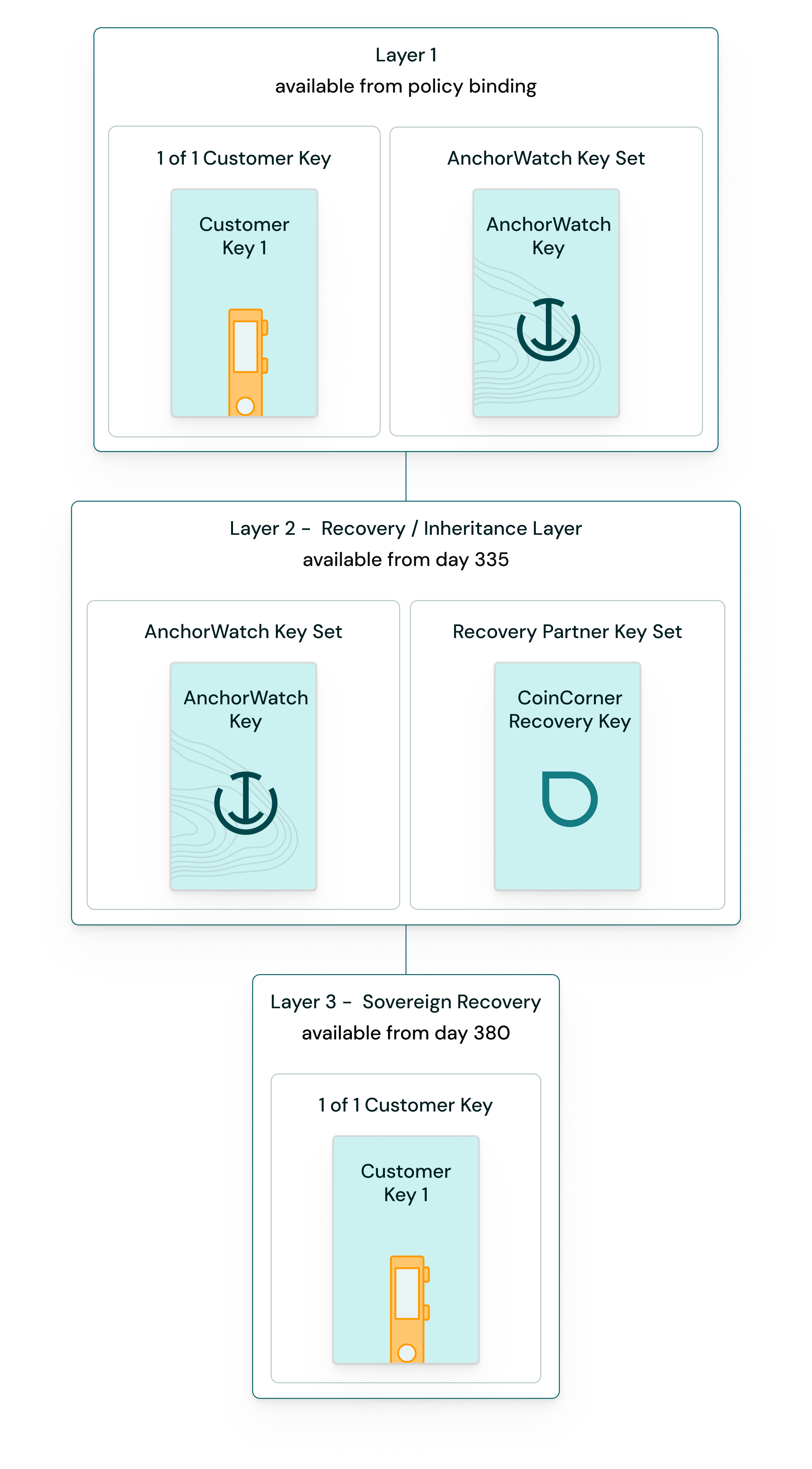
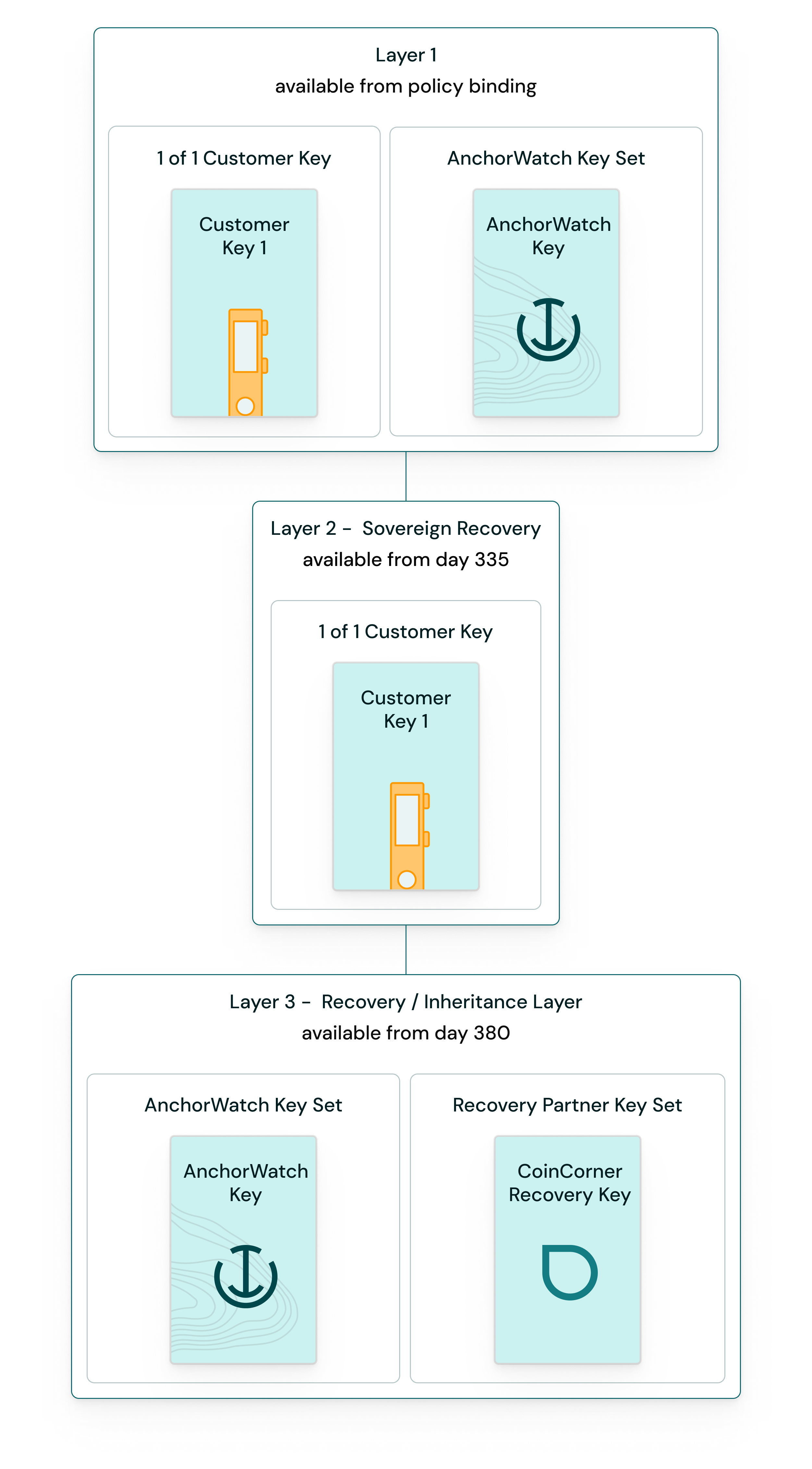
Layer 1 is the standard operating mode, active from policy binding. Your single customer key and AnchorWatch's keyset must both sign for Bitcoin to move. Neither party can act alone. If someone steals your device and tries to force a transaction, the Bitcoin still cannot move because AnchorWatch has not signed. AnchorWatch performs compliance verification on every transaction, and the team maintains a direct relationship with every client to detect social engineering, deepfakes, and coercion.
The remaining two layers are where the insured and uninsured vaults diverge.
Insured Vault:
Layer 2 is the Recovery / Inheritance Layer, available from day 335. If you have lost your key, or if you are deceased or permanently incapacitated, AnchorWatch and its independent recovery partner, CoinCorner (based in the Isle of Man, with over a decade of operational history), can recover funds using their respective keysets. This is the layer that makes inheritance work. Your keys can be lost, but your Bitcoin is not.
Layer 3 is the Sovereign Recovery layer, available from day 380, after the insurance policy ends. At this point, full control returns to your single customer key alone. If you renew the policy, the vault resets and the cycle begins again.
Uninsured Vault:
Layer 2 is Sovereign Recovery, available from day 335. Your single customer key can move Bitcoin without AnchorWatch's co-signature, giving you full sovereign control earlier in the cycle.
Layer 3 is the Recovery / Inheritance Layer, available from day 380. AnchorWatch and CoinCorner can recover funds using their respective keysets, providing the same inheritance and catastrophic recovery path available in the insured variant.
The critical insight across both configurations is the same: losing your key does not mean losing your Bitcoin. Trident converts what would be a permanent loss in any standard single-key setup into a delayed recovery scenario.
Recovery and Inheritance
Bitcoin that cannot be recovered by your heirs is not durable wealth. It is a time bomb.
The Flagship 1-Key Vault builds inheritance directly into the vault architecture. Recovery paths are defined in advance, enforced on chain, and do not depend on your heirs knowing how Bitcoin works or having access to your devices.
In the insured vault, the Recovery / Inheritance Layer activates at day 335, allowing AnchorWatch and CoinCorner to recover funds before the policy expires. In the uninsured vault, this same recovery path is available at day 380. Either way, your Bitcoin has a defined path forward even if your key is permanently lost or you are no longer alive.
This is not a feature that sits on top of custody. It is built into the vault itself.
Optional Insurance
Insurance is optional for the Flagship 1-Key Vault. The vault functions with or without it, and if insurance is not renewed, the vault continues to operate without interruption.
For clients who choose coverage, policies are underwritten by Lloyd's of London. AnchorWatch is a Lloyd's of London Coverholder, the only one in the world authorized to sell crypto-related policies to both commercial and retail customers. Lloyd's is rated A+ (Excellent) by A.M. Best.
Coverage protects against theft, coercion, wrench attacks, burglary, collusion, and permanent loss from physical perils such as fires, floods, and natural disasters.
Each vault carries its own standalone policy. Clients holding multiple vaults can select different coverage levels for each one independently. Coverage starts at a $250,000 minimum and can scale up to $100M per vault. Premiums are USD-denominated and paid upfront for annual coverage. Coverage can be increased or decreased during the year to reflect changes in asset value or risk tolerance.
Insurance does not replace good custody. It exists to transfer the catastrophic risks that sit beyond what even the best vault architecture can eliminate.
Who the Flagship 1-Key Vault Is For
If you hold your own keys and you have ever wondered what happens to your Bitcoin if your house burns down, if you are incapacitated, or if someone forces you to sign a transaction at gunpoint, the Flagship 1-Key Vault was built for exactly that concern.
It is for long-term holders who want self-custody without pretending that a single key on a single device is a complete plan. It is for people who want their Bitcoin to survive them. It is for anyone who has looked at the gap between holding a key and actually securing wealth across decades and decided that gap needs to be closed.
Self-custody does not have to be fragile. The Flagship 1-Key Vault exists to prove that.
Next Step
Talk to an AnchorWatch agent about whether the Flagship 1-Key Vault fits your situation. Email hello@anchorwatch.com or visit anchorwatch.com to schedule a call.
Contact Us
Always here to help
To request general assistance, you should contact AnchorWatch Inc, at:
To make an initial complaint, you should contact Arch Insurance at: The Complaints Manager Email: Complaints@archinsurance.com Arch Insurance (UK) Limited 4th Floor 10 Fenchurch Avenue London EC3M 5BN United Kingdom
In the alternative, you may wish to contact the Lloyd’s Complaints Department at:
Lloyd’s Complaints Department c/o Email: complaints@lloyds.comLloyd’s Phone: 1-844-849-7828 America Inc. 280 Park Avenue, East Tower, 25th Floor, New York, NY 10017, USA